Artists’ rights are in Australia’s interests
The Government is considering how copyright should apply to AI training. NAVA is advocating for artists’ consent, attribution and remuneration. A new consultation closes 9 October 2026.
The Government is considering how copyright should apply to AI training. NAVA is advocating for artists’ consent, attribution and remuneration. A new consultation closes 9 October 2026.
Debate about AI and copyright in Australia has intensified in recent weeks, following ABC reporting on confidential consultations in which the Attorney-General’s Department put forward options that could allow some copyright material available online to be used to train AI models unless rights holders opted out. This has raised concerns among artists and other creators about what an opt-out approach could mean for their rights.
In July, Prime Minister Anthony Albanese said that artists should keep ownership and control of their work, and that no company should use Australian creative work to build or train AI without that control. The Government has since opened a consultation on AI training and infrastructure in Australia. Its paper says attracting AI training to Australia should deliver a better deal for the creative and media sectors, including ensuring Australian creators can exercise control and receive payment. It also asks how Australia can encourage AI training and investment while developing standards for large data centres and AI training facilities. NAVA is preparing a response to the consultation, which closes on 9 October 2026.
Last month, NAVA made its own submissions to both the Senate inquiry into artificial intelligence and data centres and the Joint Select Committee on Artificial Intelligence inquiry, and also co-signed joint submissions with arts peak bodies, service organisations, unions and collecting societies.
Many visual artists already use AI, whether they are experimenting with generative tools in their practice or using AI for research and administration. New technologies have long changed how art is made, shared and experienced. NAVA argues that artists should have a meaningful say in how their work is used, and a share in the economic value it helps create. The debate also needs to consider rights and issues that copyright does not address, particularly First Nations cultural rights, as well as the environmental impact of the infrastructure needed to support AI.
Artists have existing rights over their work, including copyright and moral rights. As Australia considers how copyright should apply to AI, those rights should not be weakened simply because AI systems require access to very large amounts of material. NAVA’s position is that artists’ work should not be available for AI training by default. Artists should be able to opt in to the use of their work, rather than having to opt out or take action after their work has been used without permission. Visual artists’ work appears across websites, social media, galleries, collections and databases, often beyond the artist’s control. It is unrealistic to expect individual artists to discover their work has been used in an AI dataset and then pursue the company responsible.
The Government has said Australian creators should be able to control how their work is used and receive payment. NAVA supports voluntary licensing where artists decide whether their work is used and negotiate the terms and payment for that use. Licensing needs to work for individual artists as well as large rights holders, so artists can participate in and benefit from new licensing opportunities. AI companies should be responsible for seeking permission and providing transparency about the copyright material used to train their models.
Generative AI is reproducing First Nations cultural material and visual elements without understanding where they come from, who can authorise their use, or what cultural protocols apply. NAVA Members have raised concerns about AI-generated ‘Aboriginal-style’ imagery that imitates community-specific techniques, stories, motifs and mark-making without respect or consent. This spreads misinformation, harms culture and competes economically with work by First Nations artists.
First Nations artists and communities should decide whether and how their artworks, cultural material and knowledge are used. This means seeking consent before material is used, respecting any conditions around its use, and recognising that some cultural material should not be used at all. These principles are central to Indigenous Cultural and Intellectual Property (ICIP) and Indigenous data sovereignty, and cannot be addressed through a general opt-out system.
Alongside its advocacy to government, NAVA will develop good practice standards for AI for the Code of Practice for Visual Arts, Craft and Design. Members have called for clearer guidance as artists see their work and styles imitated and generative AI is used more widely across the sector. Creative Australia has established national principles for generative AI and creative work and NAVA will build on these with guidance for the visual arts, including seeking permission to use artists' work and being clear about when and how AI has been used. As with the rest of the Code, the recommendations will address practices that may be lawful but are nevertheless exploitative or unethical.
The Government’s current consultation is also considering the infrastructure needed to support AI training in Australia, including proposed national requirements for large data centres. AI data centres require significant amounts of energy, water and land, alongside the resources needed to build and operate them. Previous parliamentary work has identified energy use, greenhouse gas emissions, water consumption, land use and resource extraction among the environmental impacts associated with AI.
For First Nations communities, data-centre developments can also affect Country, cultural heritage, cultural practice and rights and interests in land and water. As Australia seeks to attract investment in AI infrastructure, decisions about where and how to build it should consider local communities and Country.
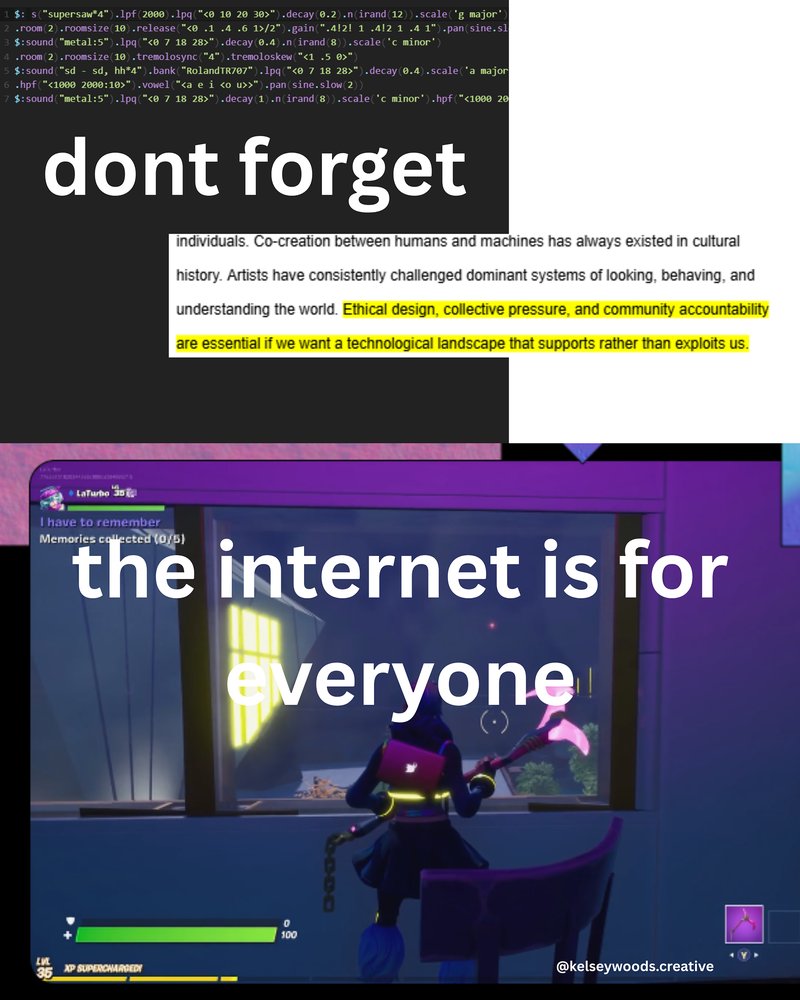
Kelsey Woods, wth is feminist ai?, 2026. Digital collage.
ID: Components of screen shots with computer generated images and text with the words "dont forget the internet is for everyone" overlayed in bold white text.



© Copyright 2026. All Rights Reserved.