A closer look at the proposed Award changes for arts workers
NAVA looks more closely at the Fair Work Commission’s proposed changes for arts workers, including what it welcomes and what still needs work.
NAVA looks more closely at the Fair Work Commission’s proposed changes for arts workers, including what it welcomes and what still needs work.
Last month, NAVA welcomed a significant Fair Work Commission decision that will see arts expressly recognised in the title of a federal modern award.
NAVA has been reviewing the draft determination in detail, drawing on pro bono legal advice from Holding Redlich and the expertise of NAVA's Board of Directors, to understand how the proposed changes would apply across the visual arts sector. This update looks more closely at what the Commission has proposed, what NAVA welcomes and the areas where NAVA is seeking changes before the determination is finalised.
The Commission has decided to rename the Amusement, Events and Recreation Award 2020 the Amusement, Recreation, Events and Arts (AREA) Award 2020. It has also published a draft determination proposing changes to the Award's classification structure to more clearly recognise visual arts work.
There is a lot to welcome. The Commission has accepted the need for an integrated classification structure that recognises the work performed by arts workers. The proposed changes would add indicative duties for particular types of visual arts work between Grades 2 and 8, and expressly recognise art centres, craft and design centres, studio spaces, residencies, art fairs, art festivals and venues for artist-run initiatives and cooperatives.
NAVA particularly welcomes the proposed recognition of appropriate training, knowledge and experience, including the Commission's recognition that knowledge may arise through cultural experience or be developed through broader experience in the arts. NAVA considers this important for recognising the different ways professional and cultural knowledge is acquired, including First Nations cultural knowledge and experience.
Many of the changes are not yet final. NAVA has received an extension until 4pm Monday 7 September 2026 to respond to the Commission's provisional views and welcomes feedback from arts workers and organisations before then.
The Commission has proposed adding “visual arts venue” to the Award's industry coverage provisions and defining the term to include a range of visual arts premises and activities.
NAVA welcomes this expanded recognition but is concerned that many visual arts organisations do not operate a permanent venue. Organisations may commission or produce work across multiple locations, deliver touring or public art programs, work from shared or temporary spaces, or operate partly or wholly online.
NAVA intends to ask the Commission to recognise both visual arts venues and visual arts organisations, so that otherwise relevant visual arts activity is not excluded simply because an organisation does not operate a permanent physical venue.
NAVA, the Media, Entertainment & Arts Alliance (MEAA) and the Australian Museums and Galleries Association (AMaGA) previously proposed a progression through the Award that distinguished between assistant and officer-level work, coordinator and adviser roles, and more advanced and specialised work.
Some of the Commission's proposed classifications differ from that structure. At Grades 7 and 8, for example, the proposed duties include managing complex exhibitions and programs, supervising professional and technical staff, managing budgets and external partnerships, developing policies and strategies, and overseeing organisational goals.
NAVA will ask the Commission to reconsider the placement of some duties to ensure that the clearer recognition of visual arts work does not inadvertently result in skilled and specialised work being classified at too low a level.
NAVA also sought changes to strengthen minimum conditions for arts workers, including penalty and overtime rates, a higher duties and mixed functions clause, and ceremonial and cultural leave for First Nations workers.
The Commission declined to consider these changes because they fall outside the scope of the current proceedings, noting that they could instead be pursued through a separate application. NAVA considers these important protections for arts workers.
The Award provides an enforceable legal minimum. NAVA will continue to maintain the Payment Standards in the Code of Practice for Visual Arts, Craft and Design as the industry standard for visual arts, craft and design.
The Commission has proposed that the changes take effect from the first full pay period on or after three months from publication of the final determination. NAVA supports this implementation period and will provide information and guidance to the sector once the final changes are known.
NAVA welcomes feedback from arts workers and organisations while the response is being finalised. If there is something in the proposed changes that you think NAVA should consider, please email nava@visualarts.net.au before Monday 7 September.
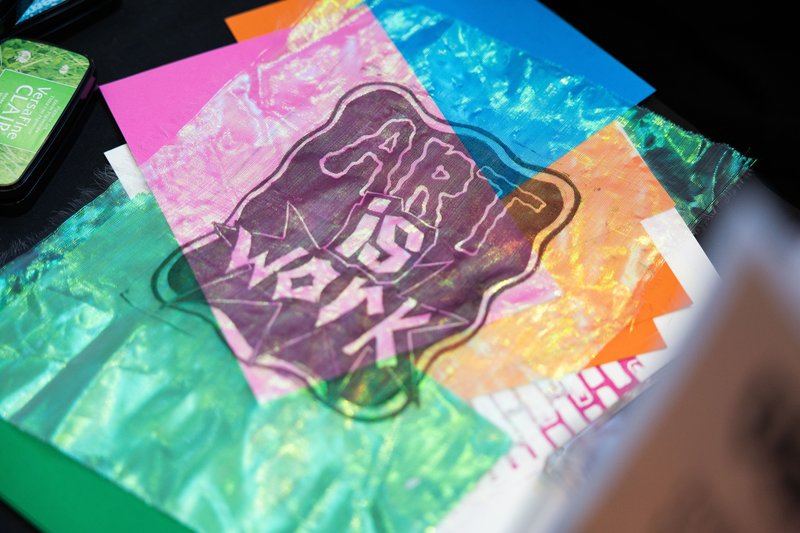
Hand-carved rubber stamp print, designed and made by artist Rachelle Esaid for NAVA's stall at Campbelltown Arts Centre's Creative Career Expo 2026, photo by Moira Vella Photography.
ID: Transparent fabric printed with the words ‘ART IS WORK’ lies over brightly coloured pink, blue, orange and green papers.



© Copyright 2026. All Rights Reserved.