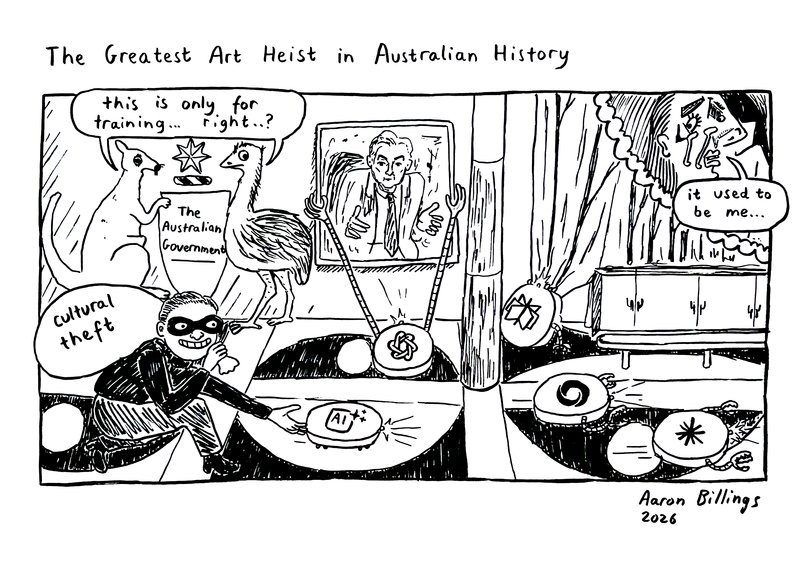
Much has been said about the theft of artists’ work by AI companies, but perhaps “heist” is a more fitting description. Theft is generally understood as taking someone else’s property without permission, while a heist involves complex coordination and a touch of stealth. Following the release of the Joint Select Committee on Artificial Intelligence report, NAVA remains concerned that changes to the Copyright Act could give legal cover to an art heist taking place right under our noses.
NAVA welcomes the Committee’s recommendations to strengthen copyright, recognise the value of creative labour and improve protections for individual artists, including against the use of generative AI to replicate their work for profit. While the Australian Government has ruled out a text and data mining exception, the report discusses other potential copyright reforms, including opt-out models and compensation funds. However the Committee’s recommendations do not explicitly rule out changes to copyright law that would allow AI companies to use artists’ work without prior consent.
“Artists should be able to share images of their work online without fearing that doing so will mean losing control over it. The scale at which AI companies want to use artists’ work is no justification for reducing artists’ rights,” said NAVA Executive Director Penelope Benton.
“This is the greatest art heist in Australian history. Artists are losing paid work to AI platforms built on artwork taken without permission or payment. Any changes to copyright law must strengthen artists’ existing rights and their ability to enforce them. Consent must be opt-in, and artists must retain the right to refuse permission and negotiate payment.”
NAVA supports opt-in collective licensing and encourages AI companies to work with existing copyright licensing agencies, or negotiate directly with artists who manage their own copyright. Artists must retain control over the use of their work, including the right to refuse permission or negotiate payment. Agreements between AI companies and major rights holders must respect the rights of individual artists. The sharing of images of artworks by gallery visitors on social media or by galleries and museums on their websites does not constitute permission for their use in AI training.
Artists need to know whether their work has been used to train AI. Mandatory disclosure of training data would help artists identify unauthorised use of their work and enforce copyright. “If AI companies can develop technology capable of replicating an artist’s work, surely they can train that technology to respect artists’ rights. Most visual artists are already struggling to earn a decent living from their work. Individual artists cannot reasonably be expected to take multinational technology companies to court to enforce their rights. The Australian Government must hold AI companies accountable for breaches of Australian copyright law.”
The report acknowledges the need to protect Indigenous Cultural and Intellectual Property (ICIP) and respect Indigenous Data Sovereignty. It also acknowledges concerns raised by NAVA and others about opt-out models. Generative AI is exacerbating the longstanding cultural and economic harm caused by the misappropriation of First Nations art, cultural knowledge and expressions, with no regard for cultural protocols. An opt-out approach is fundamentally incompatible with the principle of Free, Prior and Informed Consent. NAVA calls for AI regulation to be consistent with the Government’s commitment to standalone ICIP legislation.
The Committee’s recommendation for early and genuine consultation with workers and their representatives on the adoption and use of AI in workplaces is also relevant to organisations engaging freelance artists. NAVA is developing good practice guidance on AI use across industries that commission, reproduce or use visual artworks and designs through its Code of Practice for Visual Arts, Craft and Design. NAVA encourages organisations to consult with artists and arts workers when developing AI policies, establish clear agreements about AI use and protect artists’ intellectual property and cultural rights. Organisations should continue to commission and pay artists for their work, rather than turning to AI-generated imagery simply because it is cheaper or quicker to produce.
Through the national Not AI’s to Take campaign, NAVA is working alongside arts and media organisations across Australia to ensure the Government maintains and enforces existing copyright protections. Artists, arts workers, organisations and members of the public can support the campaign by signing and sharing the petition.
The Government must stand firm on copyright. Decisions made now about AI and copyright will affect the ability of generations of Australian artists to earn a living from their work. We cannot afford to let the greatest art heist in Australian history take place on our watch.
Image credit
Image: Aaron Billings 2026.
ID: Political cartoon illustrating parliament house being infiltrated with AI robots branded with AI company logos. The AI robots are vacuuming up all the art while Picasso's "Weeping Woman" painting cries "It used to be me".