Copyright Amendment Bill and the National AI Plan
NAVA is advocating for artist protections amid new copyright and AI policies, stressing the need for consent, payment, and ICIP protections.
NAVA is advocating for artist protections amid new copyright and AI policies, stressing the need for consent, payment, and ICIP protections.
The past fortnight has seen two important policy developments that will impact artists’ rights: the proposed Copyright Amendment Bill 2025 and the release of the National AI Plan.
NAVA has responded to the Copyright Amendment Bill 2025 and is working with the Attorney-General’s Department through the Copyright and AI Reference Group (CAIRG) to ensure the National AI Plan delivers protections for artists.
The central feature of the Copyright Amendment Bill 2025 is the introduction of a structured process for using “orphan works”, that is, copyrighted material whose creator cannot be identified or located after a genuinely diligent search. The aim is to resolve long-standing legal ambiguity and to apply only where a rightsholder truly cannot be found. NAVA has contributed to this work alongside collecting societies and cross-artform peak bodies, emphasising that any access enabled under the scheme must continue to protect artists’ economic, moral and cultural rights.
NAVA’s submission supports the Australian Copyright Council’s position that unpublished works should be excluded. The right to decide when and if a work is first made public is fundamental to artistic autonomy. Allowing access to preparatory sketches, private archives, or unfinished works risks exposing material never intended for release, and threatens artists’ control over privacy, context and timing.
Stronger protections are needed for Indigenous Cultural and Intellectual Property (ICIP). Visual artworks and archives can contain ICIP that is misidentified, poorly documented, and/or separated from the communities to which it belongs. If this material is used under the scheme, the options for responding afterwards will not be enough to address cultural harm or meet community expectations for consent, control and proper handling.
NAVA further reiterated the Copyright Agency’s position that the Bill must not be expanded to enable unpaid uses, particularly in education, which already benefits from a broad and flexible statutory licence. Any reforms must strengthen, not weaken, the cultural authority, rights and economic sustainability of artists.
This week, the Federal Government has released its first National AI Plan, setting out how Australia intends to expand AI use across the economy. Importantly, the Plan acknowledges the risks AI poses to copyright and cultural material, including the use, misattribution and falsification of First Nations cultural and intellectual property.
The Attorney-General’s Department has tasked the CAIRG, of which NAVA is a member, with advising on copyright and licensing frameworks as they relate to AI, exploring more accessible enforcement pathways for creators, and ensuring ICIP is properly protected.
The Government has already ruled out a broad text-and-data-mining (TDM) exception, which would have allowed artificial intelligence (AI) companies to freely use Australian artists’ works to train their models. This is an important win for artists. However, the National AI Plan relies on voluntary transparency measures, such as watermarking or labelling AI-generated content, which fall short of the binding protections artists need.
NAVA’s priority is ensuring that AI policy includes binding requirements for consent, payment, attribution and cultural authority, so artists retain control over how their work is used.
Both the Copyright Amendment Bill and the National AI Plan impact how artists’ work is used, licensed and protected in both traditional and AI-driven environments. As these frameworks evolve, NAVA is advocating for approaches that respect artists’ ownership of their work, uphold moral and cultural rights, protect ICIP, and ensure artists are paid wherever their work is used, in classrooms, in collections, and increasingly, in AI systems.
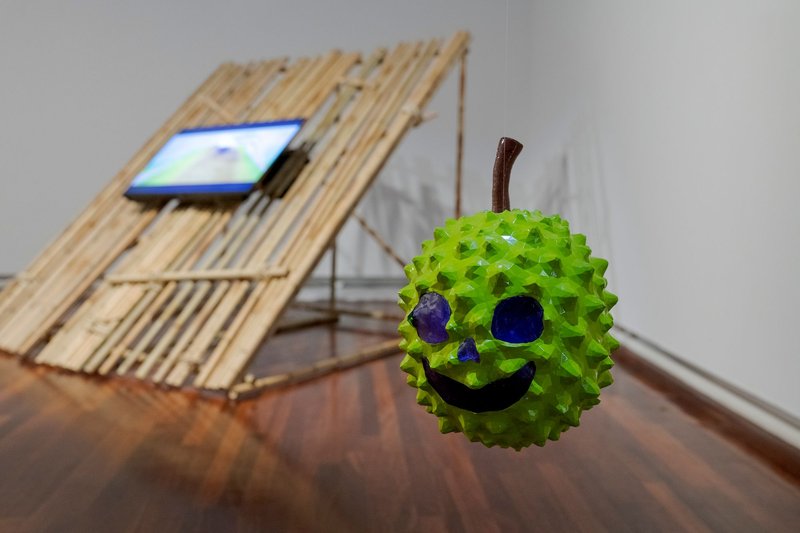
Player Count One: Studies of Bung Sadung in Fortnite (2025), by Tiyan Baker, detail view, at Goolagatup Heathcote, WA. Documentation by Aaron Claringbold.
ID: A spiky green hanging sculpture with a painted smiling face is in the foreground, with a slanted bamboo structure holding a screen in the background of a gallery space.


© Copyright 2026. All Rights Reserved.