What NAVA’s community wants for the future
NAVA’s 2026 Member Survey received 740 responses from across the continent. Thank you to everyone who took the time to contribute.
NAVA’s 2026 Member Survey received 740 responses from across the continent. Thank you to everyone who took the time to contribute.
The responses to NAVA’s 2026 Member Survey give a clear picture of the precarity that research has documented across the visual arts for decades. Almost half of respondents say their work and practice is financially unsustainable, and more than half are concerned about their professional future. Only 15.5% say their working conditions have improved over the past two years.
“The biggest change I have felt is rising costs of studio rent and art materials. I have also dropped one studio day to work/teach to remain financially afloat eg. pay my bills, and feed myself.”
Research into artists’ working lives has repeatedly documented low and irregular incomes, unpaid work and reliance on other jobs. NAVA’s own research has been part of that history, from the Visual Arts Industry Guidelines Research Project to The Big Picture in 2005 and more recent research into visual artists’ working conditions. The 2026 survey adds the experiences and priorities of NAVA Members to this longer history of research, and helps inform where NAVA should focus its work over the next decade.
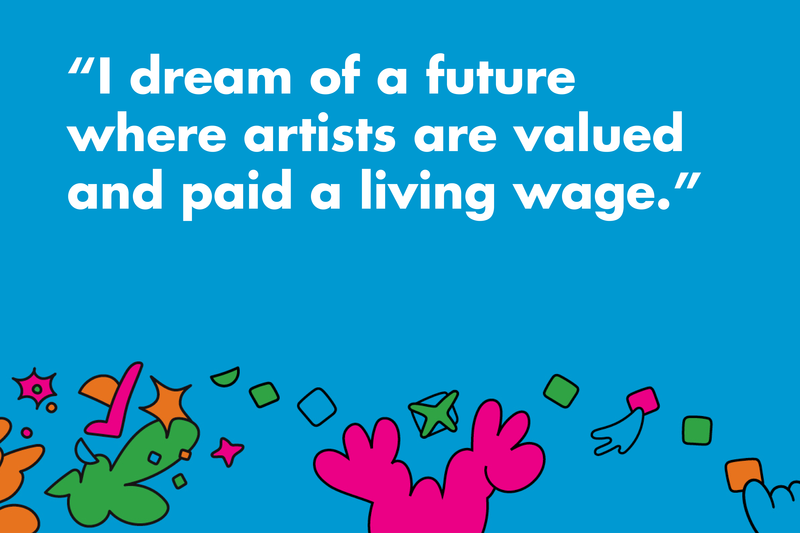
“I dream of a future where artists are valued and paid a living wage.”
NAVA asked respondents what they want the visual arts sector to look like in ten years. Across hundreds of responses, there was a strong focus on making it possible to sustain a career as an artist. Respondents want better pay and working conditions, stronger rights and protections, more sustainable careers, affordable places to work and greater recognition of art as work. They want to be properly paid, with superannuation and workplace protections, and tax settings that better reflect how artists earn income. They called for better-funded grants and arts organisations, affordable studios and places to make work, and opportunities throughout a career. Regional artists want better access to opportunities, networks and professional development.
“many many, more makers spaces and studios supported by local and regional government.”
Some respondents called for an artist wage, living wage or basic income. Others focused on arts education, safer workplaces, accessibility, First Nations self-determination and protection of Indigenous Cultural and Intellectual Property (ICIP).
“I dream that art is recognised as a profession and an artist is supported for the study and dedication given to their practice through realistic wage/payment systems with super etc.”
AI was another concern. Respondents raised copyright and artwork being used without permission, as well as the effect AI is already having on paid opportunities, income and the value placed on artists’ work.
“The impact of AI on the creative fields is extremely corrosive. I have found that organisations are trying to complete creative tasks with AI when in the past they would contract an artist. But in my case, I have been asked to complete illustration work that AI was unable to successfully complete … four times in the past 6 months. However, I know it is only a matter of months or a year before AI can successfully complete these briefs.”
86.5% of respondents rate NAVA’s advocacy as effective or very effective. People mentioned NAVA’s work on pay and working conditions, the modern award, AI and copyright, insurance and tax. They also talked about the value of artists having a national voice in government and sector discussions. But the responses also show the gap between setting standards and improving working conditions. Recommended rates have limited effect when artists continue to be offered unpaid or underpaid work. Rights can be difficult to exercise when turning down work means losing an opportunity.
The Code of Practice for Visual Arts, Craft and Design (the Code) is one way artists and organisations are using those standards in their day-to-day work. Around two-thirds of respondents use the Code often or sometimes. Artists use it to set fees, prepare quotes and grant budgets, negotiate payment, check contracts and understand their rights. Organisations use it to set artist fees and prepare agreements.
“NAVA’s Code of Practice has helped my collective to negotiate fair payments for guest artists presenting workshops.”
Some respondents said the Code gives them more confidence to negotiate. Others want it to be more widely used by organisations, galleries, funders and governments, so individual artists are not left to argue for good practice on their own.
“I feel more confident advocating for myself to be paid correctly and feel proud to know I am paying other artists properly.”
Respondents also asked NAVA for practical support, including regional and online professional development, mentoring and peer networks, grant-writing support and easier access to information about opportunities. Regional respondents spoke about isolation and limited access to networks, infrastructure and professional development.
“Put me in touch with regional networks. It’s lonely down here in the Illawarra.”
The survey comes as NAVA drafts a new ten-year Strategic Plan and three-year Action Plan for 2027–29. The draft plan is organised around four areas: recognising artists’ work as work; making good practice more widely used; strengthening artists’ rights; and building the capacity of artists and arts workers to advocate for better conditions.
The plan recognises that improving artists’ working conditions requires sustained work over time. There has been progress in some areas, but many of the conditions raised in this survey have persisted for decades. NAVA continues to advocate to the Fair Work Commission for better recognition of visual arts work in the modern award system and its recent AI submissions have called for protection of copyright and moral rights, consent and payment when artwork is used to train AI, transparency about training data and protection for ICIP. NAVA will continue updating the Code and work to increase its use by governments, funders, organisations, educators, artists and arts workers.
NAVA is also changing how it works with Members. The new Member Portal launched on 22 September, supported by a new CRM designed to improve Member engagement and give NAVA better information about how Members use its services and resources. The next stage is a new website that brings NAVA’s website, the Code and Member Portal together.
The challenge is changing conditions that research has documented for decades. The 2026 Member Survey gives NAVA a current baseline against which to measure that change: whether more artists are being paid appropriately, whether the Code is being used more widely, whether artists have stronger rights and whether more people can sustain a career in the visual arts.
NAVA cannot make those changes alone. Governments, funders, employers, galleries, commissioning bodies and others across the sector all have a role. NAVA will use the survey findings alongside other research to advocate for change and to measure whether conditions are improving.
Thank you to everyone who contributed.
Illustration by Missy Dempsey 2026.
ID: Abstract orange, green and pink shapes, including survey checkboxes and tick marks, on a bright blue background, with white text above reading, "I dream of a future where artists are valued and paid a living wage."

© Copyright 2026. All Rights Reserved.