From climate action to climate justice
Artists and organisations have a responsibility to respond to intensifying climate disasters with how they organise, who they fund and where they stand.
Artists and organisations have a responsibility to respond to intensifying climate disasters with how they organise, who they fund and where they stand.
Floods, fires, heatwaves and drought are increasingly affecting the conditions in which artists live and work. Climate anxiety, ecological grief, disaster trauma and chronic uncertainty have become features of daily life for millions of artists, arts workers and organisations, while those least responsible for the crisis are often experiencing its most severe consequences.
Art has always been central to contributing to social change. Stories, images and experiences are influential tools for exposing the often hidden connections between environmental breakdown and social inequality. While many artists are aligning their practice with the climate movement, the sector remains intimately connected to, and in many cases reliant on, funding from fossil fuel and extractive industries. With artwashing under increasing scrutiny, the climate crisis requires arts organisations to consider how they are funded, structured, and who they platform and pay.
Culture remains a missing link in Australia's formal climate strategy. The National Climate Risk Assessment (2025) affirms that effective climate adaptation depends on governance rooted in collaboration, trust, inclusion, equity and imagination, qualities that arts and cultural practice have cultivated over decades, and that First Nations cultural practice has embodied across millennia. The Climate Adaptation and Environmental Action section of the NAVA Code of Practice for Visual Arts, Craft and Design (the Code) recognises this, identifying the arts sector as essential infrastructure for preparedness, recovery, adaptation, and lasting systems change.
The Code frames climate as a social and cultural problem as much as a scientific one, inseparable from inequality, discrimination and history. Those who have contributed the least are suffering its worst impacts. Any response must include mitigation, adaptation and justice.
A significant challenge identified in the Code is the tendency to individualise responsibility for climate action. Artists, arts workers and small organisations are already stretched by precarious funding, making it difficult to demand change from larger institutions. Effective responses to the climate crisis will need to come from our large cultural institutions, whose actions have the capacity to create the most significant impact on the wider sector and beyond.
Decarbonising the sector must be done fairly, with attention to how well-intentioned sustainability measures can have unintended harm. Climate change is also interconnected with other injustices, and the Code encourages collaboration with organisations working across housing, disability justice, anti-extractive campaigns and Landback initiatives. Systemic change requires moving beyond individual action, towards collectivising strategies, building conditions of care and activating community networks.
Serious engagement with climate justice must begin with First Nations peoples, who have been sustainably caring for this continent for millennia and leading calls for urgent, transformative climate action for decades. First Nations leadership must be resourced to develop the structural initiatives that move decolonial and anti-colonial practices forward, for the material benefit of First Nations communities.
The Code calls on artists and organisations to ensure First Nations artists, Elders and leaders are in paid and supported leadership positions, to contribute a percentage of income to Pay The Rent or to local First Nations organisations, to prioritise First Nations-owned contractors, and to ensure First Nations contributors always own and are paid for their knowledge and work. Non-First Nations practitioners are recommended to allocate regular time for collective unlearning and all parties must uphold Indigenous Cultural and Intellectual Property (ICIP) principles.
Artists and organisations share a responsibility to take an intersectional, human-rights based approach to climate adaptation and justice, placing First Nations peoples first. Organisations are asked to develop a publicly accessible Environmental Justice Policy covering sponsorship, funding, project planning, energy, materials, travel and digital impacts, regularly evaluated and aligned with organisational values. An ethical sponsorship policy should give particular attention to artwashing and the social licence sought by extractive industries.
Further recommendations include establishing a climate action working group with clear accountability, commissioning climate-focused work, coordinating community cultural responses to emergencies, considering a climate emergency declaration in line with the Culture Declares Emergency movement, and developing disaster preparedness plans to protect artworks, studios and cultural heritage. Artists are encouraged to use the pvi collective's Code of Ethics Framework as a starting point, provide collaborators with a green rider detailing environmental justice requests, and ensure their investments and financial services align with their values.
Providing national coordination for this work is Creative Climate, Australia's new peak body for arts and climate, funded by Creative Australia. A First Nations and artist-led consortium bringing together Green Music Australia, A Climate for Art (ACFA), Centre for Reworlding and pvi collective, it offers leadership, advocacy and resources to support the sector's transition from a carbon economy.
The recommendations in NAVA's Code encourage artists and organisations to understand climate action as part of the work of building the more just and connected futures that artists have always been reaching toward.
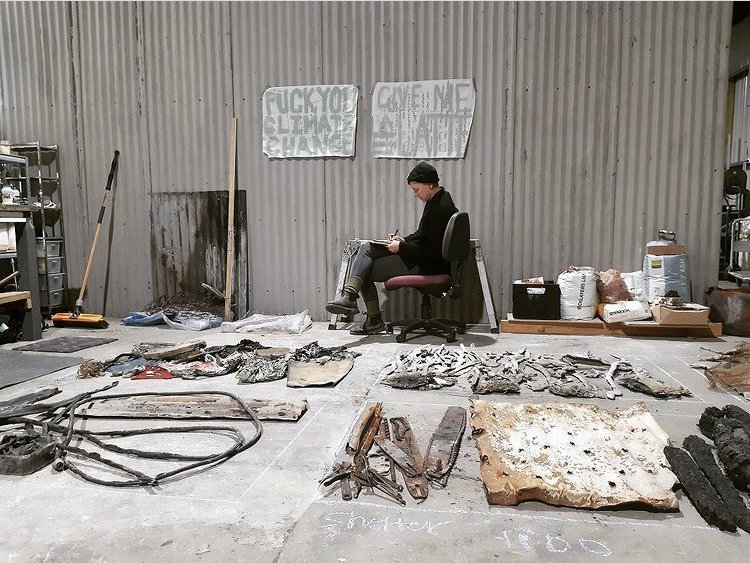
Fiona Lee, self-portrait with remnants of the artist's home, The Creator Incubator Bushfire Affected Artist Residency, Newcastle, 2020.
ID: Fiona sitting on an office chair in a damaged studio surrounded by various art materials laid out on the floor and two placards displayed on the wall reading "Fuck you climate change" and "Give me a latte".



© Copyright 2026. All Rights Reserved.