New federal laws relating to hate and extremism
NAVA is monitoring what the new legislation means for visual artists and the broader sector.
NAVA is monitoring what the new legislation means for visual artists and the broader sector.
The federal government has introduced new legislation in relation to hate crime and extremism, and NAVA is monitoring what this means for visual artists and the broader arts sector.
In early January 2026, NAVA met with advisers to the Minister for the Arts and Special Envoy for the Arts and representatives from the Office for the Arts (OFTA), alongside other national arts peak bodies. The purpose of the meeting was to raise concerns about how the then-proposed hate crime and extremism laws might affect artists, galleries and arts organisations.
This meeting took place before the Combatting Antisemitism, Hate and Extremism Bill 2026 was passed. We raised concerns about clarity, definitions, and protections for artists and organisations working with contested or confronting material. The advisers acknowledged these concerns and emphasised that implementation was still unfolding. They recognised the importance of freedom of expression for artists, but were unable to provide detailed answers at that stage.
Since then, the Bill has passed in both Houses. The legislation is framed as addressing conduct that would cause a reasonable person to fear violence, intimidation or harassment, rather than robust debate or critique. Artists and organisations are now asking what these changes mean in practice, particularly for work that engages critically with racism, colonialism, political conflict or historical trauma.
NAVA sought advice from the Arts Law Centre of Australia and their team found that some aspects of the legislation may be relevant to the arts sector in specific and limited circumstances. These include expanded provisions on hate-motivated conduct, the public display of the nazi symbol and other certain symbols, and new powers for the designation of “hate groups”. How this law will be interpreted in practice, particularly where intent, context and likely impact are contested, remains unclear and will likely be shaped over time through guidance and case law.
NAVA is actively seeking clarity on a number of unresolved questions, including how intent and context will be assessed for artistic work, how responsibility may be shared between artists and organisations, and how the legislation may intersect with funding. Some of these questions will take time to answer and may depend on formal guidance or how the law is applied in real situations.
At this stage, the primary issue is uncertainty, rather than immediate enforcement. NAVA recommends artists and curators clearly articulate artistic, critical, or educational intent through artist statements and contextual materials, as these may serve as evidence if challenged. If you are dealing with a specific situation, NAVA encourages you to seek independent legal advice. Here is the link to Arts Law’s legal query form.
NAVA is grounding its advocacy in existing freedom-of-expression protections, including those set out in NAVA’s Code of Practice, which recognises that the arts often engage with difficult ideas and challenge injustice and inequality. Some artists use charged language, symbols or imagery to critique, examine or expose harm, rather than to promote it. In the visual arts, slogans and phrases may appear within artworks, performances or exhibitions as part of inquiry, critique or historical reference, rather than as literal statements or calls to action.
We are consulting lawyers and other peak bodies, continuing dialogue with government, and monitoring how implementation unfolds, particularly for artists and organisations already working at the margins. Arts Law is also preparing information for the sector, which will be shared on their website once available.
This is a complex and unsettling moment for many in the sector. NAVA will continue to share what we know and advocate for clear and workable protections that allow artists to continue thinking critically and speaking truthfully.
If you have questions or concerns you’d like us to feed into this work, please get in touch via email nava@visualarts.net.au.
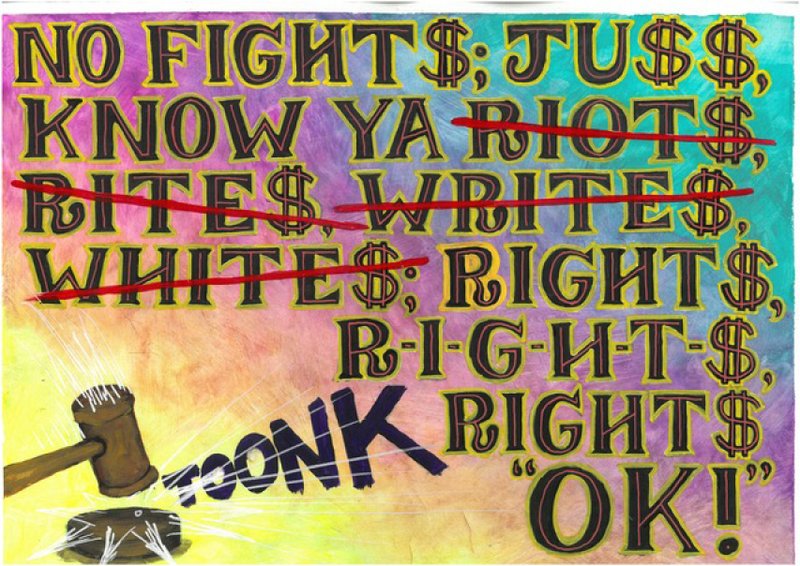
Image: Gordon Hookey, Waanyi peoples, (untitled), coloured pencil on paper, 2025.
ID: Coloured pencil illustration on a rainbow gradient background. Bold handwritten message reads “No fight$; ju$$ know ya riot$, rite$, write$, white$; right$, right$, right$ “OK!”” with some words crossed-out with a thick red line. A judge’s gavel hits a desk below.


© Copyright 2026. All Rights Reserved.