Pay the Artist
The Government is consulting on the next National Cultural Policy. NAVA is reflecting on what has changed and what hasn’t. Artists are still often not paid, or not paid enough, for the work they do.
The Government is consulting on the next National Cultural Policy. NAVA is reflecting on what has changed and what hasn’t. Artists are still often not paid, or not paid enough, for the work they do.
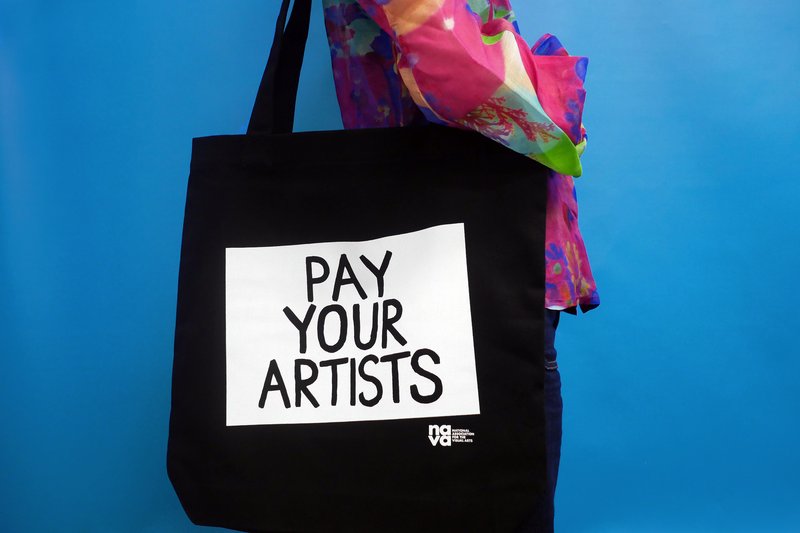
Throughout April, all new and renewing Members on an annual membership will receive a free PAY YOUR ARTISTS tote as part of this campaign.
Join or renew to support NAVA’s advocacy and submission.
The current National Cultural Policy recognises artists as workers. For artists and practitioners across the visual arts, craft and design sector, Payment Standards exist through NAVA’s Code of Practice, which was endorsed by the Government in Revive. There is greater awareness across the sector of the need to pay artists properly.
But the underlying conditions haven’t shifted in a consistent way. Artists continue to work across multiple income streams, with long periods of unpaid research and development, followed by short bursts of paid work. Income is irregular and much of the labour that goes into making exhibitions and projects is not accounted for.
Artists carry a high level of risk, with time spent on research, development and production often unpaid. Exhibitions, residencies, public programs, and opportunities that are important for building a career do not always come with fees that reflect the work involved.
This affects who can afford to stay in the sector, how long people can sustain a practice, and what work gets made and shown.
For organisations, budgets are tight. Many are receiving less funding than in previous years, and costs continue to rise. Funding often doesn’t cover the full cost of producing work. Even where there is a commitment to paying artists, it can be difficult to reflect the full cost of time and labour.
The next National Cultural Policy is a chance to address what needs to change.
If artists are to be supported as workers, the systems around them need to change. This includes how income is taxed, funding is structured, and how payment for artists is supported and applied across the sector.
Tax is one area where current settings don’t work for how artists make a living. Income is often uneven, with occasional higher-earning years alongside long periods of low income. A single grant, prize or commission can result in tax obligations that outweigh its value. It can also require GST registration or create debt that doesn’t reflect ongoing income. Targeted reform could reduce these impacts and better reflect how artists earn.
For institutions, exhibition tax relief could support production costs and artist fees, which would help to expand gallery programming and opportunities for artists.
Developing new work, undertaking residencies, or building a body of work are all essential parts of practice, but they are rarely funded in a sustained way. International models, including basic income schemes, show that more stable income allows artists to spend more time on their work and remain in the sector. Substantially increasing the number of fellowships is another way to support artists careers.
The context in which artists work is also changing. AI is creating new opportunities but also introducing new risks. There is increasing pressure to allow the use of creative work to train AI systems without permission or payment. Artists are already seeing their work used without consent, often with little transparency.
This creates a very direct risk to artists’ ability to earn. AI systems are trained on existing work, but the value generated is not flowing back to the artists who created it. There are also concerns about attribution, reputational impact, and the use of Indigenous Cultural Intellectual Property (ICIP).
Climate impacts are also affecting the sector. Natural disasters are disrupting work, damaging studios and placing collections and cultural heritage at risk. This affects how work is produced, transported and presented, and raises broader issues of infrastructure and resilience.
Artists are also navigating threats to freedom of expression, including the cancellation or postponement of exhibitions and public programs due to perceptions of risk.
Access to arts education is shrinking, affecting who can enter and sustain a career in the visual arts.
NAVA’s submission to the National Cultural Policy will focus on these structural issues, including artist income, targeted tax reform, AI regulation, arts education, and how the visual arts are supported at a national level.
The consultation process will draw on expert panels across the five pillars of the current policy. This makes it important that the specific conditions of visual arts, craft and design practice are clearly articulated.
NAVA is inviting Members to contribute to this process.
NAVA will host three online sector discussions to inform submissions on 28, 29 and 30 April 2026.
Submissions to the National Cultural Policy consultation are due 24 May 2026.
What would it take to pay artists properly?
What are the key priorities the sector wants to see in policy?
Image: PAY YOUR ARTISTS tote, with pink shirt from the Romance Was Born x Pip & Pop (Tanya Schultz) collaboration. Photo courtesy of NAVA.
ID: A black tote bag printed with the bold text “PAY YOUR ARTISTS” inside a white rectangle and the NAVA logo in the bottom right corner, carried on the shoulder of a person wearing a vibrant pink and green shirt against a bright blue background.

© Copyright 2026. All Rights Reserved.