Why reversing Job-Ready Graduates matters for the arts
Have your say on the Senate Inquiry into reversing arts degree fee hikes.
Have your say on the Senate Inquiry into reversing arts degree fee hikes.
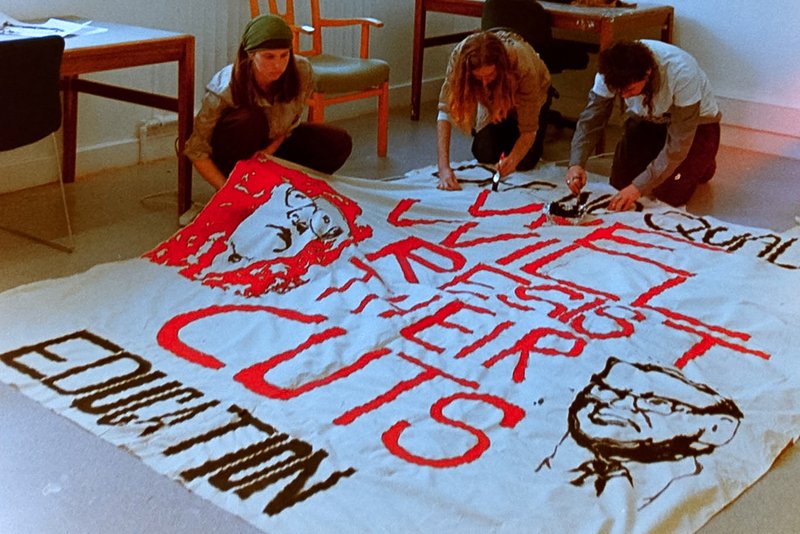
Higher education policy plays a direct role in shaping who can enter the visual arts and under what conditions. Across the country, budget cuts and faculty restructuring have affected creative arts and arts education programs in a number of universities and TAFEs.
Over the past year alone, universities in Tasmania, New South Wales, Australian Capital Territory, Queensland and South Australia have implemented or announced cuts or proposed cuts to academic roles, course offerings and degree programs in the creative arts and arts education. The National Advocates for Arts Education (NAAE) has been tracking and publishing these changes in its national tertiary snapshot, documenting reductions in staffing and program provision across multiple jurisdictions.
Introduced by the Morrison Coalition government in 2021, the Job-Ready Graduates (JRG) scheme was designed to steer students toward STEM, education and health by making arts degrees significantly more expensive. An arts degree now costs over $50,000, nine times the original 1989 student contribution, while a three-year mathematics degree costs just $13,881.
Arts graduates already earn among the lowest incomes of any graduate cohort, yet JRG placed arts degrees in the highest fee category alongside business and law, debt that many will carry for life. The Universities Admissions Centre found HECS debt influences whether 40% of Year 12 students attend university at all. Enrolment patterns in visual arts, craft and design vary significantly across states, while JRG has not meaningfully increased enrolments in its targeted priority areas. The government's own Australian Universities Accord called for the package to be fixed "before it causes long-term and entrenched damage."
Researchers Sandra Gattenhof and John Nicholas Saunders describe a "polycrisis" in arts and creative education shaped by intersecting pressures narrowing participation and weakening the pipeline into creative work. When arts education becomes harder to access through course closures and rising costs, the productivity impacts emerge downstream as skills shortages, reduced workforce entry, constrained mid-career progression and reduced capacity for innovation.
Gattenhof argues that JRG sits at the centre of that crisis, working in direct opposition to the government's own National Cultural Policy, Revive, which commits to supporting artists as workers through fair pay and sustainable career pathways. Its effects are now visible in staffing reductions and course changes reported across the country.
Workforce sustainability depends on education pathways. When arts education is weakened, the sector loses not only new entrants, but also the specialist skills that support productive practice across the ecology, including technicians, collection staff and arts educators. Long-term productivity requires education policy settings that keep visual arts education accessible and adequately resourced, sustaining the skills base on which the sector depends.
The Senate Education and Employment Committee is examining the Higher Education Support Amendment (Reverse Job-Ready Graduates Fee Hikes and End $50k Arts Degrees) Bill 2025. Submissions close 10 April 2026.
NAVA strongly encourages the visual arts, craft and design community to make a submission to the Senate Inquiry. Tell the Committee how course costs, student debt and funding reforms affect you, your career path, your organisation or community.
NAVA also encourages Members to support NAAE's campaign for urgent reform by:
Good submissions clearly address some or all of the questions or terms of reference; use examples and personal or organisational experience; explain why the committee should consider your views and what outcomes would help; and are typically 2–5 pages (though longer submissions are acceptable).
You do not need to answer every question in each inquiry. Focus on the areas that matter most to you.
Banner paint ahead of “Scrap the cuts! Fight for quality higher education!” protest, ANU School of Art and Design, 2025. Photo by Elliane Boulton, courtesy of SOAD Collective, Save Our Studies and Save our Staff (S.O.S.).
ID: Three students kneel on the floor, painting a large protest banner in red and black that reads “Scrap the cuts! Fight for quality higher education!” and features portrait illustrations.



© Copyright 2026. All Rights Reserved.