Eugenie Lee
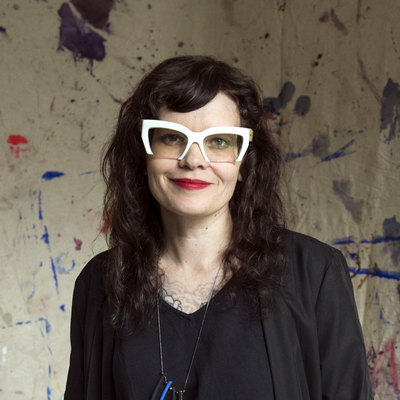
Eugenie Lee is a CripQueer, autistic, 1.5th-generation Korean-Australian interdisciplinary artist living and working on Wangal Land in Sydney.
Eugenie Lee is a CripQueer, autistic, 1.5th-generation Korean-Australian interdisciplinary artist living and working on Wangal Land in Sydney.
Eugenie Lee’s practice explores new ways of telling stories about experiences that are often misunderstood or stigmatised, including chronic pain, medical misogyny, hidden disability, and migration. Drawing from her own lived experience, she works across participatory performance, installation, sculpture, painting, and creative technologies to create experimental works that make complex, embodied experiences visible.
Collaboration is central to her practice. Lee works closely with pain scientists, neuroscientists, humanities researchers, technologists, and communities with lived experience. Through these partnerships, she explores how subjective experiences, especially those related to health and wellbeing, can be communicated in different ways.
Lee is currently developing AJUMMA [Ah-Joom-Mah] WELLBEING CLINIC, a participatory performance installation exploring speculative forms of care for women in menopausal transition, drawing on Korean middle-aged women lived experience alongside medical research and her perspective as a CripQueer diasporic artist.In partnership with ANAT (Australian Network for Art and Technology)'s Bespoke program, the project reframes menopause beyond narratives of decay and stigma, proposing alternative models of visibility and collective care.
Lee has presented work in major exhibitions and festivals including Wellbeing Garden for Access Intimacy at the Art Gallery of New South Wales (2024), Psyche at Science Gallery Bengaluru (2022) and The Wellbeing Summit for Social Change in Bilbao (2022), Breakout My Pelvic Sorcery at The Big Anxiety Festival (UNSW Galleries, 2019), and Art of Pain at the Kerry Packer Civic Gallery, University of South Australia (2015). Her work also featured in the touring exhibition The Patient Subject: New Enquiry, Documents & Engagement (2016–17).
She has received numerous grants and residencies including Arts Projects for Individuals (Creative Australia, 2026), Disability Initiative (Creative Australia, 2025), the Future Leaders Program (Creative Australia, 2022–23), a Bundanon Residency (Accessible Arts, 2020), and the Synapse Residency (Australian Network for Art and Technology, 2015). The Synapse Residency marked a significant shift in her practice, leading to sustained collaboration with neuroscientists researching chronic pain.
Lee holds a Bachelor of Visual Arts (First Class Honours) from Sydney College of the Arts.
In this interview, Lee reflects on how interdisciplinary collaboration reshaped her practice, particularly her early work alongside chronic pain researchers. She speaks about the high cost of a research-intensive practice and the persistence required in applying for grants. She also discusses how, as a NAVA Member, NAVA’s Code of Practice supports her in valuing her labour, preparing for collaborations, and advocating for fair payment.
Video production by Atypical 2025.
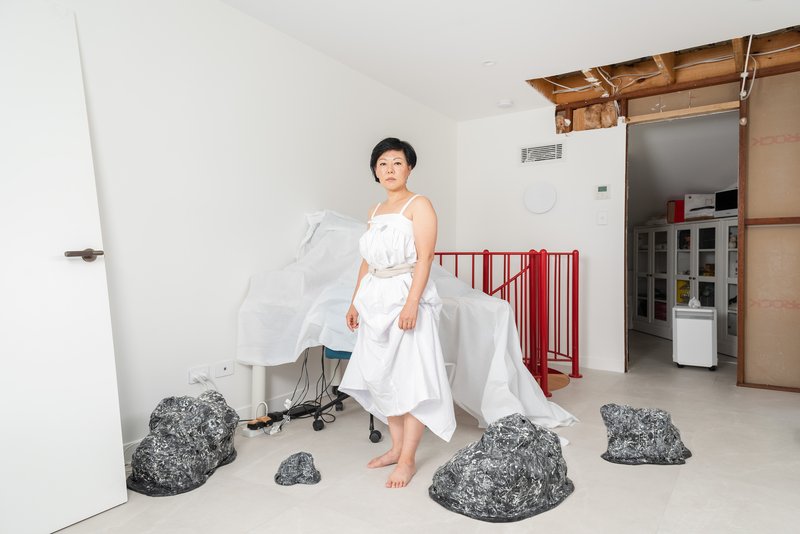
Image: Eugenie Lee, photo by Garry Trinh, 2026.
ID: Photo of Eugenie Lee standing barefoot in a white sculptural dress in a minimal space, with dark rock-like forms on the floor.
About NAVA
The National Association for the Visual Arts (NAVA) is a Membership organisation that brings together the many voices of the contemporary arts sector to improve fundamental conditions of work and practice. We do this through advocacy, education and the Code of Practice.



© Copyright 2026. All Rights Reserved.