Introducing the proposed new NAVA Constitution
Members will be asked to vote on the approval and adoption of the Constitution at the upcoming General Meeting.
Members will be asked to vote on the approval and adoption of the Constitution at the upcoming General Meeting.
As shared with Members in December 2025, NAVA has been reviewing and updating its governing document over the past few years to modernise and strengthen the organisation’s core governance framework. The proposed new Constitution replaces NAVA’s existing Articles of Association, which were drafted under older state-based corporations legislation. NAVA operates as a national membership organisation and registered charity.
Members will be asked to vote on the following Special Resolution at the upcoming General Meeting:
That the Members approve and adopt the Constitution tabled at the meeting as the Constitution of the National Association for the Visual Arts Ltd, replacing the existing Articles of Association, and authorise the Board to make any minor amendments required by applicable law.
A summary of the key changes and what has remained the same is provided below.
The proposed new Constitution does not change NAVA’s fundamental purpose or character.
NAVA’s core purpose remains to promote, support and advocate for the visual arts, craft and design sector.
Members continue to:
Membership remains open to individuals and organisations connected to or supportive of the visual arts.
There is no limit on the number of Members.
Members are still required to pay an annual Membership fee. There will be no change to the current Membership terms, including monthly payments for Premium Members.
NAVA remains a not-for-profit public company limited by guarantee. Members’ liability remains capped at $5.
Income and assets cannot be distributed to Members.
The Board can refuse Membership applications in certain circumstances.
The Board has a maximum of 10 Directors, with Members electing the majority of the Board.
National representation remains a requirement, with Directors continuing to come from at least four states or territories.
The changes modernise the Constitution, align it with contemporary charity and governance standards, and clarify how Membership and governance operate in practice.
Alignment with national charity law
The previous Articles referenced older state-based corporations legislation, including the Companies (New South Wales) Code and Corporations Law.
The new Constitution aligns with the Corporations Act 2001 (Cth) and the Australian Charities and Not-for-profits Commission (ACNC) Act, reflecting NAVA’s status as a Registered Charity.
Updated terminology and language
The new Constitution updates terminology throughout to reflect contemporary legal drafting, national regulation, inclusive language, and removal of outdated state-based references.
Acknowledgement of Country and ICIP
The new Constitution embeds NAVA’s commitments to First Nations artists and arts workers by including an Acknowledgement of Country, recognition of Indigenous Cultural and Intellectual Property (ICIP) and cultural protocols, and increased Aboriginal and/or Torres Strait Islander representation on the Board.
New preamble
The preamble provides greater clarity about what NAVA is, why it exists, and the principles that guide its work.
Clearer Objects
To comply with charity law requirements, the new Constitution expresses NAVA’s objects explicitly as charitable purposes, including advancing culture, promoting and protecting human rights, and contributing to public debate.
It also more clearly reflects NAVA’s role in advocacy, standards-setting, and work to improve conditions for artists and arts workers within the visual arts sector.
Membership
The new Constitution:
The new Constitution formally recognises different classes of Membership, reflecting NAVA’s existing Membership structure in practice.
It updates provisions relating to the Register of Members to reflect current legal and privacy requirements.
Under the previous Articles, a Member could cease Membership through a resolution of the Company. The new Constitution instead links Member removal to broader governance and disciplinary provisions elsewhere in the Constitution, creating a more structured process.
If future changes would alter Members’ rights or obligations, those changes would require approval by Special Resolution.
Board composition
The previous Articles required fixed representative categories (Artists, Organisations, Aboriginal and Torres Strait Islander Representative Directors, and Co-opted Directors).
To strengthen artist and First Nations representation, while allowing flexibility to address governance skills and sector needs, the new Constitution moves to a composition-based model requiring:
If Board composition requirements temporarily fall out of balance, Board decisions remain valid while the Board takes reasonable steps to restore compliance.
The new Constitution also adds clearer requirements for maintaining a Board Charter outlining expertise, qualifications, and collective capabilities.
A new Treasurer section has been added, including appointment by the Board, responsibilities set out in the Board Charter, and removal by Board resolution.
The new Constitution allows for one or more Chairpersons (including Co-Chairs) and one or more Deputy Chairpersons.
New governance provisions include:
Director Terms
Previously, Elected Directors served two-year terms and could be re-elected twice, while Co-opted Directors served one-year terms and could be reappointed up to five times. Directors could serve a maximum of six continuous years.
To support continuity, stability and longer-term strategic planning, while maintaining a clear limit on tenure, Directors now generally serve three-year terms before standing for re-election (a maximum of six years remains).
Technology and accessibility
The new Constitution allows virtual and hybrid meetings, as well as electronic voting.
Gift Fund and DGR clarity
To protect NAVA’s Deductible Gift Recipient status (DGR) and ensure regulatory compliance, the new Constitution includes detailed Gift Fund provisions aligned with Australian Taxation Office (ATO) requirements.
New Dispute Resolution provisions
The new Constitution introduces a formal dispute resolution process for disputes about the interpretation, application or alleged breach of the Constitution involving Members, Directors and NAVA. The process encourages disputes to be resolved in good faith before formal mediation and includes provisions for culturally appropriate mediation where disputes involve Indigenous Cultural and Intellectual Property (ICIP).
Members are encouraged to read the proposed Constitution and summary of changes prior to the meeting.
If you are unable to attend the AGM, you may appoint a proxy using the form provided below.
To participate in the AGM and vote on the Special Resolution, please register via the meeting link included in the Notice of Meeting.
For any questions regarding the proposed Constitution or AGM process, please contact NAVA at nava@visualarts.net.au.
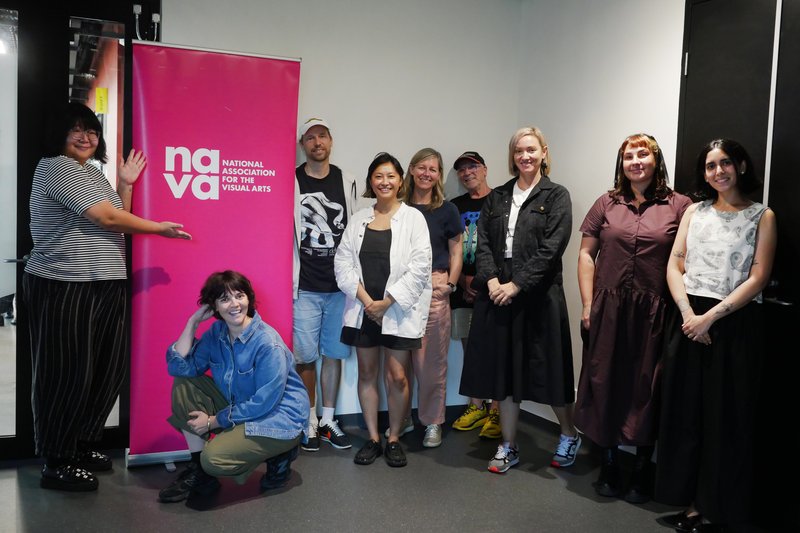
NAVA Board at a strategic planning session, 9 February 2026. L to R: Sophia Cai, Liz Nowell, Ryan Presley, Jamie Lewis, Janice Falsone, Brian Tucker, Sophia Sambono, Rebecca Ray, Nandini Sathyamurthy.
ID: Photo of a large group of people standing and crouching beside a pink pull up banner with the NAVA logo.
The NAVA Board, and the artists, arts workers and organisations we represent, are based across hundreds of sovereign nations and unceded lands throughout the continent colonially known as Australia.
We acknowledge Aboriginal and Torres Strait Islander peoples as the first artists and storytellers on this continent, and pay our respects to First Nations ancestors, Elders and communities.
Sovereignty was never ceded. Always was, always will be Aboriginal land.


© Copyright 2026. All Rights Reserved.